
Somewhere between your aunt's Facebook feed and the halftime ads during Sunday football, a $10.6 billion industry materialized. Sweepstakes casinos — platforms where you technically buy virtual "Gold Coins" and receive "Sweeps Coins" as a promotional bonus — have become one of the most lucrative and legally contested corners of the American gaming market. According to a KPMG industry primer referencing Eilers & Krejcik Gaming data, gross revenue for the sweepstakes casino sector surpassed $10.6 billion in 2024, with net revenue topping $3.4 billion. Those are not projections. Those are receipts.
The audience driving these numbers doesn't match the stereotype of a Vegas regular nursing a whiskey at a penny slot machine. Roughly 58% of sweepstakes casino users fall in the 25-to-44 age bracket, according to industry trend data. In fact, the average age of casino players in the United States has dropped from 49.6 years in 2019 to 41.9 years by 2024 — a shift driven in large part by the accessibility and low barrier to entry of sweepstakes platforms. An estimated 55 million Americans now play sweepstakes games annually. These are mobile-first users, often in states where regulated online casinos don't exist, looking for something that feels like gambling without technically being classified as such.
This guide exists because most of what you'll find written about US sweep slots casinos reads like an advertisement wearing an editorial hat. Rankings with no methodology. "Reviews" that are just affiliate links stacked between SEO keywords. We take a different approach: data over hype. Every claim in this article traces back to a verifiable source — KPMG reports, AGA surveys, Eilers & Krejcik Gaming monitors, IRS publications. We analyze the business model, break down the legal chaos unfolding across states in 2026, evaluate platforms on metrics that matter, and tell you what the industry's own numbers reveal about player odds and safety.
Sweepstakes casinos are not going away — but they are changing fast. Six states enacted bans in 2025. Four more have introduced prohibition bills in the current legislative session. The largest operator, VGW, reported over $6 billion in global revenue. Class action lawsuits have surpassed the hundred mark. Whether you're a player trying to figure out which platform is worth your time, or someone trying to understand what this industry actually is, this guide gives you the numbers and lets you decide for yourself.
The Sweep Slots Landscape in Five Hard Numbers
- The sweepstakes casino industry grossed over $10.6 billion in 2024, but six state bans in 2025 triggered a forecast downgrade — EKG now projects a 10% net revenue decline for 2026, to $3.6 billion.
- Only 12% of users ever make a purchase, and the average buy is under $10. The operator payout rate across the industry is 68-72%, meaning roughly $30 of every $100 spent never comes back to players.
- California (17.3% of all sales) and New York ($762M market) banned sweepstakes casinos in 2025. Florida, Indiana, Maine, and Mississippi have introduced similar bills for 2026.
- Ninety percent of sweepstakes casino players say they're gambling. Eighty percent spend money monthly. These are not "free-to-play" statistics.
- VGW (Chumba Casino, LuckyLand Slots) dominates with $6.13 billion in global revenue. Over 100 class action lawsuits were filed against operators in 2025.
How the Sweepstakes Casino Model Generates Billions
The Dual-Currency Architecture
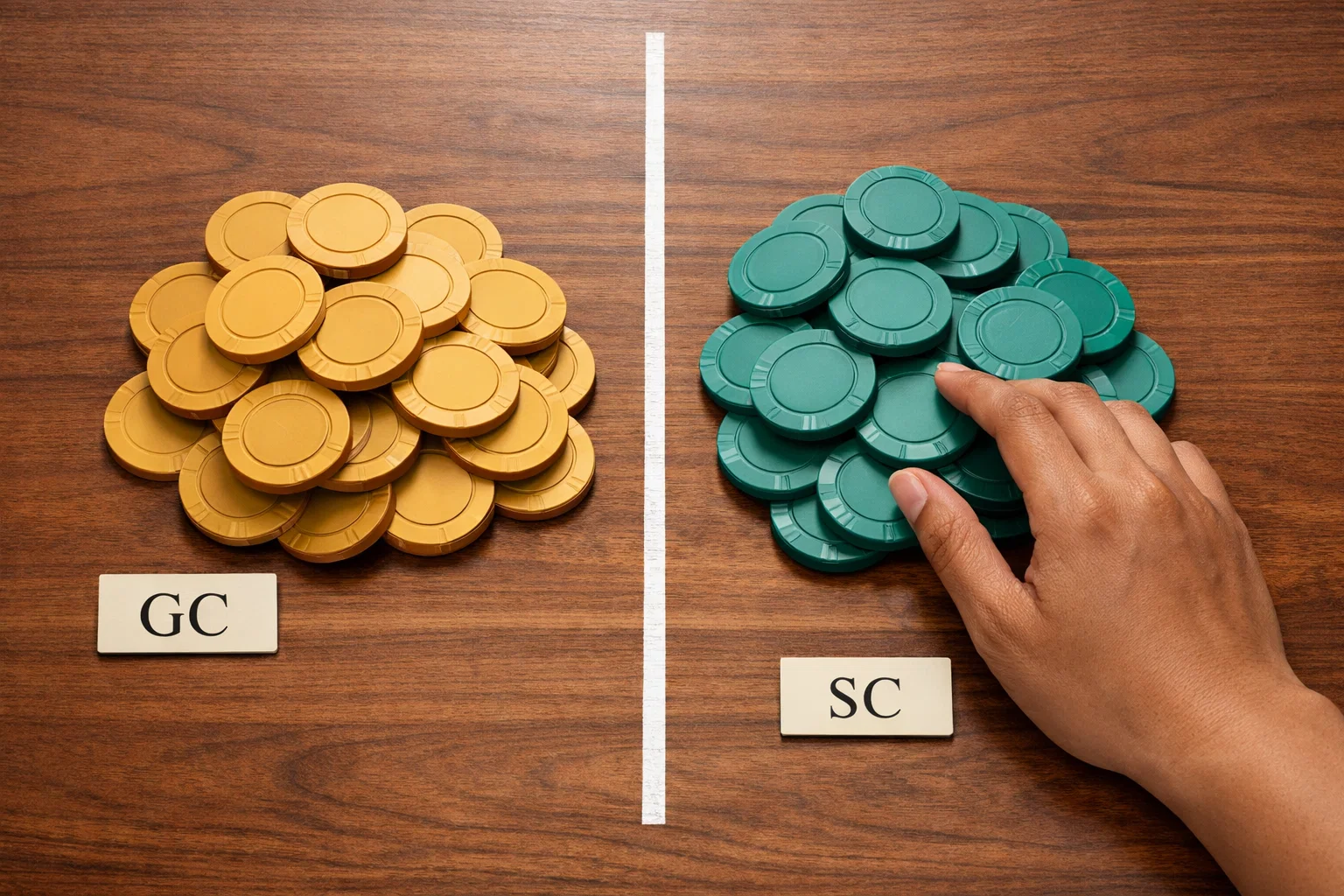
Every sweepstakes casino operates on the same foundational trick: a dual-currency system designed to sidestep gambling law. Players purchase Gold Coins (GC), the platform's play-money currency, in packages that come bundled with a "free" promotional bonus of Sweeps Coins (SC). Gold Coins have no cash value. Sweeps Coins, however, can be redeemed for real cash prizes once a minimum threshold is met. The legal argument is straightforward — you're buying a virtual entertainment product, and the sweepstakes component is merely a promotional giveaway.
This distinction is the load-bearing wall of the entire industry. As Magnus Boberg, founder of JustGamblers, explained: "Traditional gambling requires three elements: consideration, chance, and prize. Sweepstakes sites do not require payment, so they bypass regulations that apply to traditional online gambling." The "no purchase necessary" clause is satisfied through an Alternate Method of Entry (AMOE) — typically a mail-in request or a social media giveaway — that allows players to obtain Sweeps Coins without spending a dime. In practice, AMOE participation is vanishingly small. The overwhelming majority of Sweeps Coins in circulation are acquired through Gold Coin purchases.
The numbers tell the story of just how much money flows through this "non-gambling" system. Sweepstakes casinos generated $10 billion in Gold Coin purchases during 2024 alone, according to Eilers & Krejcik Gaming research conducted for the Social Gaming Leadership Alliance. That's not gross revenue or market capitalization — that's direct consumer spending on virtual coins, in a single year, on platforms that claim they aren't casinos.
The Conversion Funnel and Whale Economics
The business model's profitability depends on a pattern familiar to anyone who has studied free-to-play gaming: the vast majority of users never pay, and a small minority funds the entire operation. Data from EKG's Social Sweepstakes Gaming Monitor, analyzed by RG.org, shows that only about 12% of sweepstakes casino users ever make a purchase. Compare that to regulated gambling apps, where conversion rates typically exceed 50%. The typical purchase amount is under $10. The economics here mirror the mobile gaming whale model: most players are free riders, a moderate slice buys occasionally and cheaply, and a thin top tier of high-volume purchasers generates an outsized share of total revenue.
This dynamic has implications for how you should evaluate bonus offers and platform economics. When a sweepstakes casino gives you 10,000 Gold Coins and 2 Sweeps Coins for a $4.99 purchase, they're counting on most buyers never redeeming those Sweeps Coins — and on a handful of buyers cycling through $500+ packages on a regular basis. The platform's margin comes from the spread between Gold Coin sales and Sweeps Coin redemptions.
Customer Acquisition and the Cost of Growth
Running a sweepstakes casino is not cheap, despite the regulatory savings. Gaming Innovation Group's investor data from 2024 pegged the customer acquisition cost (CAC) in the sweepstakes segment at $50 to $100 per user — lower than traditional regulated gaming but still substantial when you consider the 12% conversion rate. Operators need to acquire roughly eight or nine free users for every one who opens a wallet. Celebrity endorsement deals, social media advertising blitzes, and aggressive welcome bonus structures all serve one purpose: getting users past that first purchase.
The math explains why VGW, the parent company of Chumba Casino and LuckyLand Slots, reportedly spent approximately $300 million on celebrity-fronted advertising campaigns. When your per-user economics depend on volume at the top of the funnel and high lifetime value from a sliver at the bottom, marketing spend becomes existential rather than optional. It also explains why the industry reacts so viscerally to state bans — losing access to a state doesn't just remove a revenue stream, it removes the top of a funnel that was already expensive to fill.
US Legal Landscape in 2026: Bans, Bills, and Billions at Stake
The 2025 Ban Wave
The legal ground beneath sweepstakes casinos shifted dramatically in 2025. Six states enacted legislative bans on sweepstakes casino operations: Montana, Connecticut, New Jersey, California, New York, and Nevada (through strengthened enforcement of existing gambling statutes). That list is not a collection of regulatory backwaters. It includes the nation's largest state by population and two of its most established gambling markets. The regulatory consensus that sweepstakes casinos existed in a comfortable gray area evaporated faster than most operators expected.
California's ban hit the industry hardest. Governor Newsom signed AB 831 in October 2025, effective January 1, 2026, with penalties of up to $25,000 per violation and up to one year of imprisonment. California accounted for approximately 17.3% of all sweepstakes sales in the United States, according to EKG data. AB 831 went further than most bans by extending liability to third-party vendors — payment processors, software providers, and advertising partners that facilitate sweepstakes casino operations. The bipartisan nature of the vote stunned even insiders. As Shawn Fluharty, West Virginia Delegate and President of the National Council of Legislators from Gaming States, put it: "[Sweepstakes] couldn't get one vote in California. You know how hard that is? They can't agree on the colour of the carpet."
New York followed a different but equally devastating path. The state's sweepstakes market generated $762 million in sales during 2024. Governor Hochul signed S5935 into law, and Attorney General Letitia James issued cease-and-desist orders to 26 operators. The combined loss of California and New York removed roughly a quarter of the industry's domestic revenue base in the span of a few months.
2026 Legislative Session: Four New Fronts
The ban wave has not crested. In the 2026 legislative sessions, at least four states have introduced bills targeting sweepstakes casinos: Florida (HB 591), Indiana, Maine, and Mississippi (SB 2104). Florida alone represents an enormous potential loss — the state's combination of population size, demographic profile, and limited regulated iGaming options makes it one of the highest-volume sweepstakes markets in the country.
Mississippi's SB 2104 is particularly noteworthy because it follows the California playbook of extending liability beyond operators to vendors and service providers. The bill's sponsors have cited the same reasoning that drove AB 831: if you can't shut down offshore-operated platforms directly, you can cut off their domestic supply chain — the payment processors, the ad networks, the hosting providers.
The financial impact of this regulatory trend is already measurable. Eilers & Krejcik Gaming revised its 2025 net revenue forecast downward, from $4.7 billion to $4 billion, following the ban wave. The firm's target="_blank" rel="nofollow"2026 projection calls for a further 10% decline to $3.6 billion in net revenue. This is not the trajectory of an industry that has regulatory risk under control.
Where Sweepstakes Casinos Still Operate
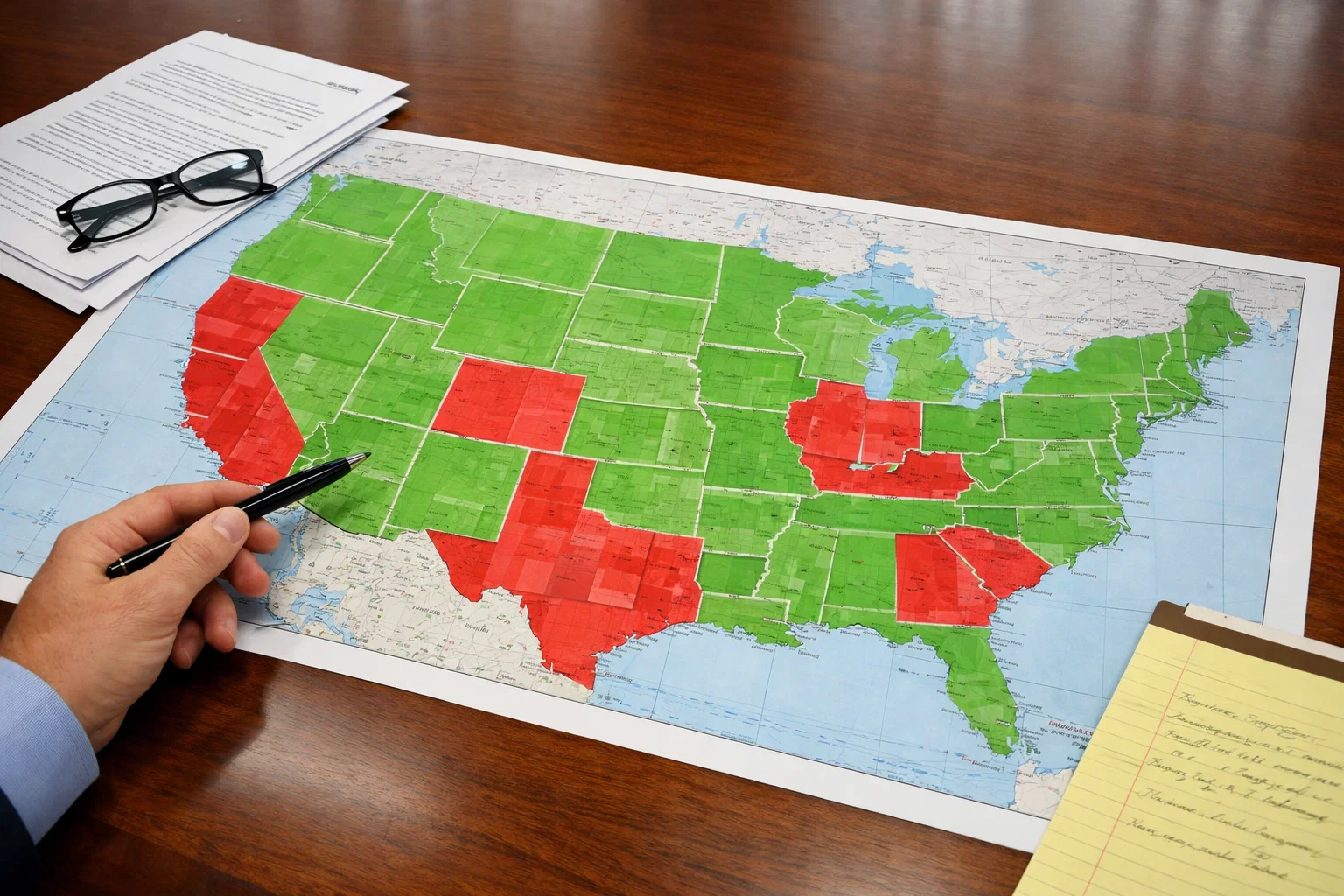
Despite the bans, sweepstakes casinos remain accessible in the majority of US states. The operational map in 2026 still covers more than 40 states, though the composition of that map matters. States with mature regulated gambling markets — New Jersey, Nevada, Connecticut — have been the quickest to act. States without legalized iGaming, where sweepstakes casinos face less organized opposition from incumbent operators, remain the industry's strongholds.
Tres York, Vice President of Government Relations at the American Gaming Association, framed the industry's trajectory in stark terms: "In 2026, we will continue the fight to protect the legal, state-regulated, and tribal gaming markets from illegal and unregulated gambling." The language is deliberate — the AGA does not refer to sweepstakes casinos as a gray area or an alternative model. It calls them illegal gambling. Whether that characterization holds up legally in every state is an open question, but the political momentum is running in one direction.
Sweepstakes casinos · coin math
Sweeps Coin Value Calculator
Two numbers decide what a coin package is actually worth to you: the playthrough requirement and the redemption minimum. The first costs far less than most players assume — the second is what really stands between a balance and a prize redemption.
How the requirement changes things
A 1× playthrough is genuinely cheap: at 96% RTP you keep about 96 cents on the dollar in expectation. It's the higher multiples that bite — each additional pass through the balance compounds the house edge, which is why a 5× requirement quietly removes a fifth of the value.
Does bet size help?
Here's the part that surprises people: with a fixed target, betting smaller does not improve your odds. Tiny bets mean many more spins, and every spin hands the house its edge again — so the grind works against you. The redemption minimum, not the playthrough, is what most balances never survive.
For information and entertainment only; results are modeled from the values you enter. No purchase necessary to play or redeem. 18+ (21+ where required); void where prohibited. If gambling stops being fun, call 1-800-GAMBLER.
Market Overview: From Explosive Growth to Recalibration
The Numbers Behind the Boom
The sweepstakes casino sector did not grow — it erupted. Between 2022 and 2024, the industry's total addressable market expanded at a compound annual growth rate of 31%, climbing from $3.1 billion to well beyond initial forecasts, according to Gaming Innovation Group's investor presentation. The gross revenue figure for 2024 — exceeding $10.6 billion per KPMG's analysis of Eilers & Krejcik data — stunned even bullish analysts. To put that in context, the entire US commercial casino industry generated $78.72 billion in gross gaming revenue across 2025, a record year. Sweepstakes casinos, operating without state gaming licenses, without regulatory oversight in most jurisdictions, and without paying state gaming taxes, captured a gross figure equivalent to roughly 13% of the regulated industry's total.
KPMG's forward-looking estimates, drawn from EKG's Social Sweepstakes Gaming Monitor, projected 2025 gross revenue exceeding $14.3 billion with net revenue above $4.6 billion. Those projections were assembled before the full weight of the 2025 ban wave landed. The gap between gross and net revenue — roughly $10 billion in the difference — reflects the industry's operating mechanics: Gold Coin purchases represent the top line, while Sweeps Coin redemptions, operational costs, and marketing spend consume the majority of incoming dollars.
The Correction
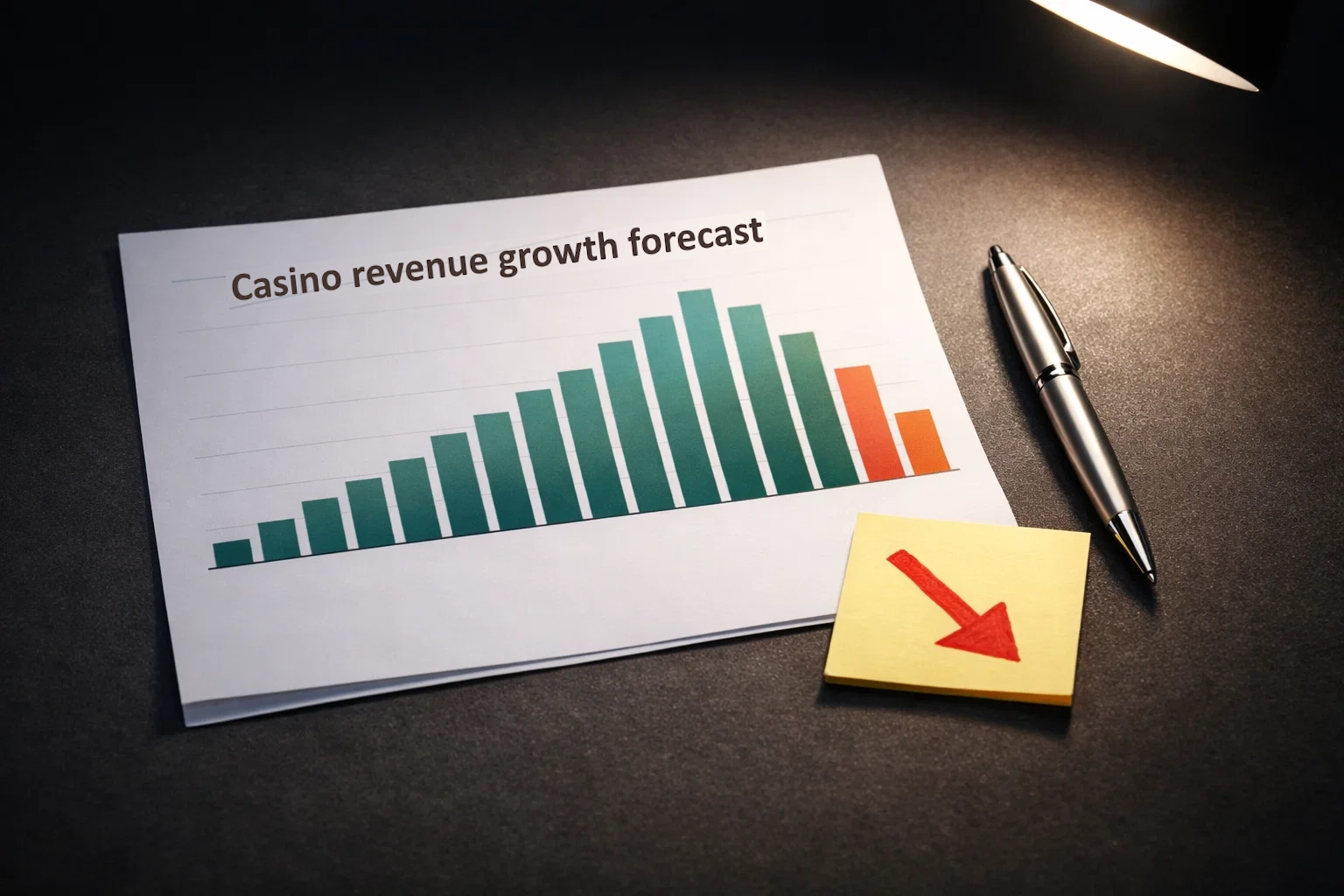
Growth rates that triple an industry in three years tend to attract two things: more competitors and more regulators. The sweepstakes sector got both in 2025, and the result was the first meaningful downward revision in the industry's short history. EKG adjusted its 2025 net revenue forecast from $4.7 billion to $4 billion — a 15% cut driven primarily by the California and New York bans. The 2026 outlook is worse: a projected 10% decline to $3.6 billion in net revenue.
RG.org's 2026 scenario analysis offers a wider range. Their base case projects Gold Coin purchases of $12 to $13 billion, Sweeps Coin redemption payouts of $8.5 to $9.5 billion, and net revenue of $3.6 to $4.2 billion. The variance in those numbers hinges almost entirely on how many additional states enact bans and how aggressively existing bans are enforced. If Florida and Indiana follow through on their 2026 bills, the lower end of that range becomes the more plausible outcome.
Market Concentration
The sweepstakes casino market is dominated by a small number of operators to a degree that would raise antitrust eyebrows in most other industries. VGW Holdings — parent company of Chumba Casino, LuckyLand Slots, and Global Poker — reported global revenue of $6.13 billion and profit of $491.6 million for its fiscal year ending June 2025. A single company commanding that share of a $10.6 billion gross revenue market tells you this is not a fragmented, competitive landscape. It's an oligopoly with a long tail of smaller platforms fighting over margins.
The concentration has practical implications for players. Platform quality, bonus generosity, game selection, and payout reliability vary enormously between the top three or four operators and the dozens of smaller entrants. It also means that regulatory action against a single large operator — VGW has faced more than 20 class action lawsuits — can create market-wide ripple effects that smaller platforms neither cause nor can absorb.
Evaluating Sweep Slots Platforms: Our Methodology
Most sweepstakes casino "reviews" are affiliate content dressed up as analysis. The operator with the highest commission rate gets the top ranking. We use a different system — one built on measurable criteria that a player can independently verify.
Our evaluation framework weighs five categories, each scored on publicly available or directly testable information. Licensing and legal standing comes first: where is the operator incorporated, which states does it serve, has it been subject to regulatory action or litigation, and does it maintain transparent terms of service? A platform that has received cease-and-desist orders or operates in states that have enacted bans gets flagged regardless of how good its slot selection might be.
Game selection and provider quality forms the second pillar. We look at the number of available titles, but more importantly, we examine which studios supply the games. Platforms sourcing from established providers — Pragmatic Play, NetEnt, Hacksaw Gaming — offer independently audited RTP values and fair RNG implementations. Platforms running proprietary games with no third-party certification present a transparency gap that players should weigh carefully.
Payout mechanics receive heavy scrutiny. The industry-wide operator payout rate averages 68% to 72% according to RG.org's analysis — we explain what that figure means and why it differs from game-level RTP in the slots section below. What matters for platform evaluation is how individual operators compare against that benchmark, and how accessible their redemption process is. We evaluate minimum thresholds, processing times, KYC friction, and available withdrawal methods. A platform that offers fast, low-minimum cashouts demonstrates operational confidence in its player economics.
Bonus structure and true value form the fourth criterion. We calculate the effective SC-to-dollar value of welcome packages, daily login bonuses, and ongoing promotions, accounting for any playthrough requirements. A $10 package that comes with 30 Sweeps Coins with a 1x playthrough is meaningfully different from the same package with a 3x requirement — though many review sites present them as equivalent.
Responsible gaming tools and player protection round out the evaluation. We assess whether the platform offers self-exclusion, deposit limits, session timers, and reality checks. We note whether the operator provides clear information about the odds of games and whether customer support is accessible through multiple channels with reasonable response times. In an unregulated space, voluntary adoption of responsible gaming measures signals an operator that plans to exist in five years, not just five months.
Platform Comparison at a Glance
The following table summarizes key metrics across the most prominent sweepstakes casino platforms operating in the US as of early 2026. Note that game counts and bonus structures change frequently; the data below reflects conditions verified at the time of publication. VGW's platforms dominate the market — the parent company's $6.13 billion in global revenue for FY24/25 dwarfs all competitors combined.
| Platform | Parent Company | Approx. Game Count | Welcome Bonus (Typical) | Min. SC Redemption | Payout Speed | Notable Providers |
|---|---|---|---|---|---|---|
| Chumba Casino | VGW Holdings | 150+ | 2 SC on signup | $100 (100 SC) | 3-7 business days | Proprietary (VGW) |
| LuckyLand Slots | VGW Holdings | 80+ | 10 SC free on signup | $50 (50 SC) | 3-7 business days | Proprietary (VGW) |
| Stake.us | Medium Rare N.V. | 500+ | 25 SC + 250K GC | $50 (50 SC) | 1-3 business days | Pragmatic Play, Hacksaw, Push Gaming |
| WOW Vegas | Wow Entertainment Ltd. | 800+ | 5 SC + 250K GC | $100 (100 SC) | 1-5 business days | Pragmatic Play, Betsoft |
| Pulsz Casino | Yellow Hat Ltd. | 700+ | 5,000 GC + 2.3 SC | $50 (50 SC) | 1-5 business days | Pragmatic Play, NetEnt, Hacksaw |
| McLuck | Blazesoft Ltd. | 600+ | 7,500 GC + 5 SC | $50 (50 SC) | 1-5 business days | Pragmatic Play, NetEnt |
A few patterns emerge from this comparison. VGW's platforms (Chumba, LuckyLand) offer fewer games and rely on proprietary software, but benefit from the longest operational track record and the deepest player base. Newer entrants like Stake.us, WOW Vegas, and Pulsz compete on game volume and provider diversity, licensing titles from studios whose slots appear in regulated European and US markets. The trade-off between established trust and modern game libraries is the core decision most players will face when choosing a platform.
Minimum redemption thresholds range from $50 to $100 — a meaningful difference for casual players who may never accumulate enough Sweeps Coins to cash out on higher-threshold platforms. This is not a trivial detail. A $100 minimum effectively locks low-spend players into the ecosystem indefinitely, which is precisely the intent.
Slots Worth Playing: RTP and Volatility Snapshot
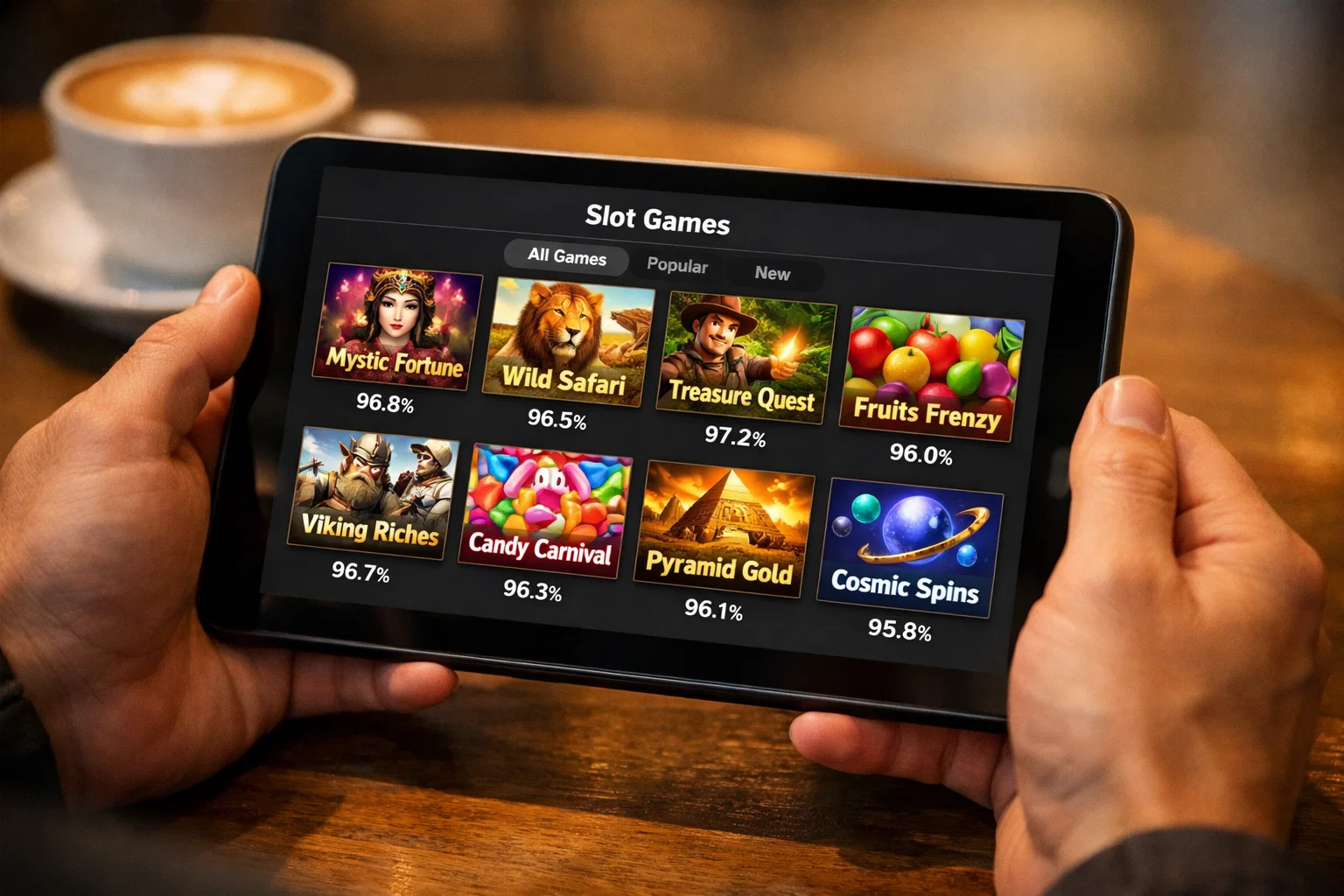
Return to Player (RTP) is the single most important number in any slot game, and it's also the number most sweepstakes casino review sites either misunderstand or deliberately obscure. RTP represents the theoretical percentage of wagered money that a slot returns to players over an extended period — millions of spins, not your Tuesday afternoon session. A slot with 96% RTP is mathematically expected to return $96 for every $100 wagered. The remaining $4 is the house edge.
On sweepstakes platforms that source games from established studios, posted RTP values typically range from 94% to 97%, with occasional outliers reaching higher. These figures mirror what the same titles offer in regulated European and US markets, because the software is identical — the studio's server determines the outcome regardless of whether the game runs on a licensed New Jersey casino site or a sweepstakes platform. When you play a Pragmatic Play title on Stake.us, the RNG and math model are the same as on a UK-licensed operator.
The distinction that matters — and that most players miss — is between individual game RTP and operator payout rate. A slot may have a 96.5% RTP, but the operator's aggregate payout rate sits between 68% and 72% per RG.org's analysis. How is that possible? Because the operator payout rate measures the ratio of total Sweeps Coin redemptions to total Gold Coin purchases across the entire player base. Most players never redeem. Many play through their Sweeps Coins without meeting the minimum threshold. The operator keeps the unredeemed balance. The 96.5% RTP applies to each individual spin; the 68-72% payout rate reflects the systemic economics of a model where most participants are net contributors, not net recipients.
Volatility: What It Means for Sweep Slots Play
Volatility — sometimes labeled variance — describes the distribution pattern of wins. A high-volatility slot pays out less frequently but delivers larger individual wins when it does hit. Low-volatility slots produce smaller, more regular payouts. Medium volatility splits the difference. The RTP can be identical between a high-vol and low-vol slot; the difference is entirely in how that return is distributed over time.
For sweepstakes casino players, volatility interacts with the redemption threshold in ways that matter. If your platform requires 100 SC to cash out and you're playing a high-volatility slot, you need a large enough bankroll of Sweeps Coins to survive the dry spells between big hits. A low-volatility slot gives you more consistent play and a more predictable path to the redemption floor, but the ceiling is lower. Neither approach is inherently better — but understanding which profile a game has is essential to managing your SC balance intelligently.
Titles Worth Noting
Among the widely available titles on major sweepstakes platforms, a few stand out for their favorable player math. Gates of Olympus (Pragmatic Play) offers 96.5% RTP with high volatility and a popular multiplier mechanic. Sweet Bonanza (Pragmatic Play) carries 96.49% RTP at high volatility, with cluster-pays that make for extended session times. Starburst (NetEnt), a classic low-volatility option, provides 96.09% RTP with a win-both-ways structure that favors bankroll preservation. For players interested in Megaways mechanics, Big Bass Bonanza Megaways delivers 96.71% RTP with the variable-reel system that can produce substantial multiplier stacks.
The caveat here is important: not all platforms offer every title, and some sweepstakes casinos run proprietary games with unpublished or unaudited RTP values. If a platform cannot tell you the RTP of a game — or if the information is buried behind multiple clicks — treat that as a data point about the platform's transparency, not as an irrelevant omission.
Bonuses That Actually Add Value
Welcome Bonuses: Decoding the Real Offer
Every sweepstakes casino leads with a welcome bonus, and every welcome bonus is designed to look more generous than it actually is. The typical structure bundles a large number of Gold Coins — which have zero redeemable value — with a smaller number of Sweeps Coins that can eventually become cash. When a platform advertises "250,000 Gold Coins + 25 Sweeps Coins FREE on signup," the economic value of that offer is entirely in the 25 SC. At a 1:1 SC-to-dollar redemption rate, the welcome package is worth $25 in potential prize money — assuming you meet any playthrough requirements and hit the minimum redemption threshold.
Playthrough requirements vary significantly across platforms. Some sweepstakes casinos require a 1x playthrough on SC received through bonuses, meaning you must wager the SC once before becoming eligible to redeem. Others impose 3x or even 5x requirements. The difference is substantial: 25 SC with a 1x playthrough gives you $25 worth of play and whatever remains after wagering. The same 25 SC with a 5x playthrough requires $125 worth of wagering before you can redeem, which — at a 96% average RTP — leaves you with roughly $20 in expected value before the first redemption is even possible.
The most player-friendly welcome offers in the current market come from platforms competing for market share against VGW's entrenched incumbents. Newer operators like Stake.us, McLuck, and Pulsz tend to offer more Sweeps Coins in their initial packages, with lower playthrough multipliers, because they're buying player acquisition with thinner margins. This is a rational strategy for a new entrant, but it also means that the most generous bonuses may not come from the most established or trustworthy operators.
Daily Login Bonuses and Loyalty Programs
Beyond the welcome offer, most sweepstakes casinos provide daily login bonuses — small allocations of Gold Coins and Sweeps Coins credited simply for visiting the platform each day. The individual daily value is modest, typically ranging from 0.3 to 1 SC per day, but the compounding effect over weeks of consistent play adds up. A player who logs in daily for a month at an average of 0.5 SC per day accumulates 15 SC — a small but free contribution toward the redemption threshold.
VIP and loyalty programs exist at most major sweepstakes casinos but operate with less transparency than their regulated-casino counterparts. Tiered systems typically reward cumulative Gold Coin purchases with enhanced bonuses, faster redemption processing, and increased SC awards. The specific earn rates and tier thresholds are rarely published in full, making independent comparison difficult. What we can say is that loyalty programs overwhelmingly reward purchase frequency and volume — they are designed to increase player spending, not to reward skillful play or disciplined bankroll management.
No-Deposit Bonuses: The Loss Leader
No-deposit bonuses — SC awarded at registration without any purchase requirement — are the sweepstakes casino equivalent of a loss leader. The amounts are small (typically 2 to 10 SC), and the intent is straightforward: get you into the platform, let you experience the gameplay loop, and convert you into a paying customer. These bonuses have genuine value for players who want to evaluate a platform's game quality and user experience before committing money. They have very limited value as a path to meaningful cash prizes, given that the average platform requires $50 to $100 in SC for a first redemption.
The smart approach to sweepstakes casino bonuses is to treat them as information-gathering tools rather than profit opportunities. Use no-deposit bonuses and daily logins to test platforms. Evaluate the game selection, the interface responsiveness, the customer support quality. When and if you decide to purchase Gold Coins, do so with the understanding that the welcome bonus is a marketing cost baked into the platform's player economics — not a gift.
Player Safety and the Fairness Question
What Players Already Know
The sweepstakes casino industry's central marketing claim — that these platforms are entertainment products, not gambling — collides with what their own customers say. A 2025 survey of 2,250 players conducted by the American Gaming Association found that 90% of sweepstakes casino users consider their activity to be gambling. Sixty-nine percent described sweepstakes casinos specifically as venues for wagering real money. The semantic distinction between "purchasing Gold Coins with a promotional Sweeps Coin bonus" and "placing a bet" may hold up in some courtrooms, but it does not hold up in the minds of the people actually using these platforms.
The spending data reinforces the point. The same AGA survey revealed that 80% of sweepstakes casino players spend money on a monthly basis, with nearly half reporting weekly expenditures. These are not casual users occasionally dropping $5 for entertainment. The behavioral profile matches that of regular gamblers — which is exactly what regulators in states like California and New York concluded before enacting their bans.
Tres York, Vice President of Government Relations at the AGA, summarized the regulatory perspective bluntly: "These operators present themselves like legal, regulated platforms — but they operate outside the law and regulation." Whether you agree with that characterization depends on your reading of each state's gambling statutes, but the consumer perception data makes the industry's "this isn't gambling" position increasingly difficult to defend.
Advertising and Its Implications
The visibility of sweepstakes casinos in the US digital advertising landscape is staggering. According to data from Sensor Tower compiled by the AGA, sweepstakes casinos accounted for 50% of all online casino advertising in early 2025. Half of every casino ad a US consumer encountered online was for a platform that, in the industry's own framing, isn't actually a casino. That level of advertising saturation has regulatory consequences: it draws attention from lawmakers, consumer protection agencies, and the established gambling industry, all of whom have reasons to push for tighter controls.
The advertising intensity also shapes player expectations. When celebrity-endorsed campaigns featuring production values that rival regulated gaming ads funnel users into platforms with weaker player protections, the disconnect between the marketing promise and the operational reality creates trust issues that affect the entire sector. A player who signs up expecting a fully regulated gaming experience — because the ads looked indistinguishable from a DraftKings commercial — is likely to be disappointed by the support infrastructure, the payout timelines, and the limited recourse options available on most sweepstakes platforms.
The Regulation Gap
The fundamental safety concern with sweepstakes casinos is not that they're scams — the major platforms do pay out, and the games from reputable providers do run on certified RNG systems. The concern is what's missing. Regulated online casinos in states like New Jersey and Michigan operate under frameworks that mandate player protection measures: self-exclusion registries linked across all licensed operators, mandatory responsible gambling tools, independent auditing of game outcomes, separation of player funds from operational accounts, and regulatory complaint mechanisms with enforcement authority.
Sweepstakes casinos adopt some of these measures voluntarily. Most offer self-exclusion and deposit limits. Few participate in cross-platform exclusion registries. None are subject to the kind of routine compliance auditing that regulated operators undergo. The result is a consumer protection framework that depends entirely on the operator's goodwill rather than external enforcement. For the top-tier platforms with reputational stakes and legal exposure, voluntary compliance may be adequate. For the long tail of smaller operators with limited track records, the absence of mandatory standards leaves players relying on faith where they should be relying on oversight.
FAQ
How do sweepstakes casinos work?
Sweepstakes casinos operate on a dual-currency model. Players purchase Gold Coins (GC), which are virtual play-money tokens with no cash value, in bundled packages that include a promotional bonus of Sweeps Coins (SC). Gold Coins are used for entertainment-only play. Sweeps Coins, once accumulated above the platform's minimum redemption threshold (typically $50 to $100 worth), can be redeemed for real cash prizes. The legal basis for this model is the "no purchase necessary" requirement: platforms must offer an Alternate Method of Entry (AMOE) — usually a mail-in request or social media promotion — that allows players to obtain Sweeps Coins without buying anything. In practice, the overwhelming majority of SC enters circulation through Gold Coin purchases. The sweepstakes model is designed to satisfy promotional sweepstakes laws rather than gambling statutes, though six states banned the model in 2025 and others are actively pursuing similar legislation. For a detailed breakdown of the mechanics, including how AMOE actually works and what redemption looks like in practice, see our complete guide to how sweepstakes casinos work.
Can you really win real money at sweepstakes casinos?
Yes — through the Sweeps Coin redemption process, players can and do receive real cash prizes. The mechanism is legitimate: once you accumulate SC above the platform's minimum threshold and complete identity verification (KYC), the platform converts your Sweeps Coins to cash, typically at a 1 SC = $1 rate, and sends the funds via bank transfer, check, or in some cases cryptocurrency. The more important question is how likely you are to come out ahead. Industry data analyzed by RG.org shows that the average operator payout rate falls between 68% and 72% — meaning that across the entire player base, $68 to $72 is returned for every $100 spent on Gold Coin packages. Individual results vary widely based on game selection, volatility, and simple luck. The majority of players, particularly those who never redeem or who play through their SC before hitting the threshold, contribute more than they receive. Statistically, sweepstakes casinos function like any other negative-expectation game: a small number of players win meaningful amounts while the majority subsidize those winnings plus the operator's margin. For more on what real player outcomes look like, see our analysis: can you win real money at sweepstakes casinos.
What states ban sweepstakes casinos in 2026?
As of early 2026, six states enacted explicit legislative bans on sweepstakes casinos during 2025: Montana, Connecticut, New Jersey, California, New York, and Nevada (through strengthened enforcement). California's AB 831, signed by Governor Newsom in October 2025 and effective January 1, 2026, carries penalties of up to $25,000 per violation and extends liability to third-party vendors. New York's S5935 prompted cease-and-desist orders to 26 operators from Attorney General Letitia James. In the 2026 legislative session, four additional states have introduced bills targeting sweepstakes casinos: Florida (HB 591), Indiana, Maine, and Mississippi (SB 2104). Idaho and Washington maintain older statutes that effectively prohibit the model as well. The regulatory trajectory is clearly toward further restriction rather than accommodation. For a detailed breakdown of each state's status, enforcement approach, and the implications of pending legislation, see our guides to sweepstakes casino legal states and banned states in 2026.
Where This Industry Goes Next
The US sweepstakes casino market in 2026 sits at an inflection point that will determine whether it matures into a regulated sector or contracts into irrelevance. The numbers on both sides of the ledger are large. Gross revenue exceeding $10.6 billion proves there is genuine consumer demand for accessible, low-barrier casino-style gaming. More than 100 class action lawsuits filed in 2025, per Gambling Insider reporting, prove there are equally genuine legal and consumer protection questions that the industry has not answered.
Three scenarios seem plausible for the next two to three years. In the first, the ban wave continues and accelerates. If Florida, Indiana, and several other states follow California and New York, the accessible market shrinks to a size where only the largest operators remain viable. EKG's projected 10% net revenue decline for 2026 becomes the optimistic case, and smaller platforms exit or consolidate. The second scenario involves a negotiated regulatory framework — something like what the Social and Promotional Games Association (SPGA) has advocated for — where operators accept licensing requirements, state gaming taxes, and mandatory player protections in exchange for legal certainty. This path would transform sweepstakes casinos from a legal gray area into a recognized, if heavily taxed, gaming vertical. The third possibility is a messy middle ground: ongoing state-by-state legal battles, inconsistent enforcement, and a market that continues to operate in the gaps between legislation and prosecution.
For players, the practical takeaway is straightforward. The platforms are real, the games work, and the redemption process pays out — but the environment surrounding these platforms is changing faster than most participants realize. A platform that is legal in your state today may not be tomorrow. A bonus structure that looks generous this month may disappear when the operator's marketing budget contracts in response to a new ban. Approach sweepstakes casinos for what the data says they are: a form of entertainment with real financial risk, operating in a regulatory environment that is moving against them.
This guide exists to give you numbers where others give opinions. Data over hype. If the industry earns a regulated future, we'll be here to analyze it. If it doesn't, we'll document that too.